
BMI, which stands for body mass index, is still one of the most commonly used tools for checking whether a person’s weight falls into a general category such as underweight, healthy weight, overweight, or obesity. It is easy to calculate, widely recognized, and often used in doctor’s offices, online tools, and health charts. Even so, many adults over 60 eventually ask an important question: is BMI still accurate later in life?
The honest answer is that BMI can still be useful, but it is not always as precise for older adults as people may think. It gives a quick reference point, but it does not tell the full story. After 60, natural changes in muscle mass, body composition, bone density, mobility, and overall health can make a simple BMI number less meaningful on its own. That does not mean BMI is useless. It means it should be treated as one piece of the bigger picture rather than the final answer.
What BMI Actually Measures
BMI uses height and weight to place a person into a general category. It does not directly measure body fat, muscle, waist size, fitness level, hydration, or strength. That is one of the main reasons it can be misleading for some people. Two adults can have the exact same BMI while having very different bodies and very different health risks.
For a younger adult with stable muscle mass and few health concerns, BMI may serve as a rough screening tool. For an older adult, things can become more complicated. Someone may weigh more because they carry extra body fat, but someone else may weigh less because they have lost muscle. On paper, one BMI may look better than the other, yet the person with less muscle may actually be more fragile, weaker, or at greater risk of falling.
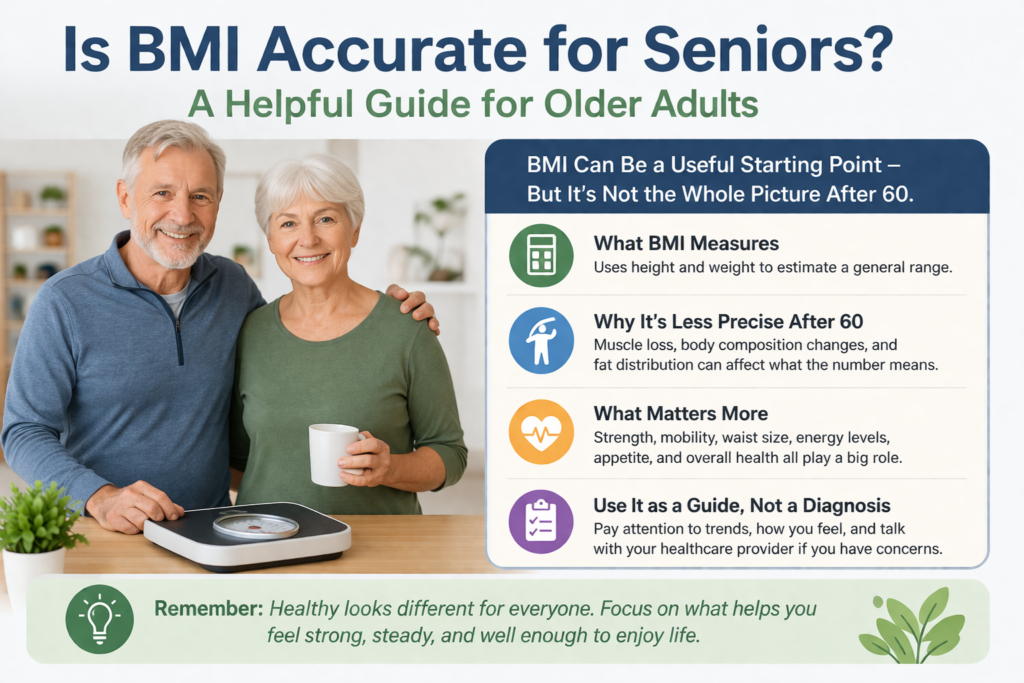
Why BMI Becomes Less Precise After 60
As the body changes over time, weight alone becomes a weaker measure of overall health. Many older adults gradually lose muscle mass, especially if they are less active, recovering from illness, or eating less protein than they need. This change can lower body weight without improving health. In some cases, a lower BMI may look positive on paper while actually reflecting muscle loss or reduced strength.
Body fat distribution can also shift. Some adults carry more weight around the midsection even when their BMI remains in a normal range. That matters because abdominal fat may be linked with higher health risk. At the same time, an older adult with a slightly higher BMI may still be active, strong, and doing very well overall. This is one reason many health professionals look beyond the number on the scale.
Bone density, medications, swelling, hydration, and certain health conditions can also affect body weight. BMI does not separate any of these factors. It simply compares height to weight and assigns a category. That simplicity is what makes it convenient, but it is also what limits it.
Can BMI Still Be Useful for Seniors?
Yes, BMI can still be useful as a starting point. It can help older adults and caregivers notice whether weight may be trending too low, too high, or changing in a way that deserves attention. It can also make it easier to understand general medical language during routine visits. If a doctor refers to underweight or overweight categories, BMI helps provide a basic framework.
The key is to use BMI in the right way. It should be seen as a screening tool, not a diagnosis. A BMI result may prompt a closer look at nutrition, physical activity, mobility, waist size, energy levels, appetite, and medical history. Used this way, it can still be helpful. Problems usually happen when the number is treated as the whole story.
When BMI May Be Misleading in Older Adults
BMI may be misleading when an older adult has lost muscle mass but not much body fat. In that case, the BMI might look acceptable even though strength and resilience have dropped. It may also be misleading when someone has a more muscular build, carries weight differently, or is dealing with fluid retention or another condition that affects the scale.
It can also be less helpful when unintentional weight loss is involved. A drop in weight may lower BMI, but the change itself may be more important than the category. Losing weight without trying can sometimes point to illness, poor nutrition, medication side effects, dental problems, trouble eating enough, or other issues that deserve attention.
That is why many older adults benefit from asking not just, “What is my BMI?” but also, “Has my weight changed recently?” “Am I feeling strong?” “Is my waist size increasing?” and “Am I eating and moving in a way that supports my health?”
Why Being Underweight Can Matter Too
Conversations about BMI often focus on overweight and obesity, but being underweight can also be a concern after 60. In older adults, low body weight may sometimes be linked to muscle loss, lower reserves during illness, reduced appetite, weakness, or nutritional gaps. It may also increase the risk of frailty in some individuals.
This is one reason a very low BMI should not automatically be celebrated. A thinner body does not always mean a healthier one. In some cases, maintaining enough weight to support strength, balance, and energy may be more important than trying to stay at the lower end of a chart.
What Matters More Than BMI Alone
For older adults, health is often better understood by looking at several factors together. Strength matters. Mobility matters. Appetite matters. Waist size may matter. Energy levels, blood pressure, blood sugar, balance, and the ability to stay active all matter too. These things can tell a more complete story than BMI by itself ever could.
For example, someone with a slightly higher BMI who walks regularly, eats well, sleeps decently, and remains independent may be in a stronger position than someone with a lower BMI who is weak, sedentary, and losing weight without trying. A chart can provide context, but real-life function and daily well-being often tell more.
Should Seniors Ignore BMI Completely?
No, most older adults do not need to ignore BMI completely. It still has value as a simple reference. The better approach is to keep it in perspective. Think of it as a quick screening number rather than a final judgment about your health.
If your BMI falls outside the usual range, that does not automatically mean something is wrong. It may simply mean it is worth paying closer attention. If your BMI is within the standard range, that also does not automatically mean everything is ideal. The number should always be interpreted alongside how you feel, how you function, and what your doctor sees in the bigger picture.
What Older Adults Should Do With a BMI Result
If your BMI result seems higher or lower than expected, the most useful next step is not panic. It is context. Look at whether your weight has been stable or changing. Notice whether you have lost strength, energy, or appetite. Consider whether your waist size has increased. Think about your movement habits, your meals, and how you feel day to day.
If something seems off, bring that information into a conversation with your healthcare provider. A doctor or dietitian can help interpret the result in a more personal way. That matters because healthy weight is not identical for every adult over 60. One person may feel and function best at a weight that would not perfectly match a standard chart.
A Better Way to Think About Healthy Weight After 60
A healthier mindset is to focus less on chasing one exact number and more on maintaining a stable, supported body. That means protecting muscle, staying active in ways that feel realistic, eating enough nourishing food, staying hydrated, and paying attention to changes that happen without explanation.
For many adults over 60, the goal is not to become as light as possible. The goal is to stay capable, steady, energetic, and well enough to enjoy daily life. A BMI chart can be one helpful reference along the way, but it should never outweigh common sense, lived experience, or medical guidance.
Final Thoughts
So, is BMI accurate for seniors? It is accurate enough to serve as a general screening tool, but not accurate enough to tell the full story by itself. Later in life, body composition changes, muscle loss, waist size, overall strength, and medical history all become more important. That means BMI still has a place, but it works best when paired with other signs of health.
If you use a BMI chart or weight tool, treat the result as a starting point. Let it guide questions, not fear. Let it support awareness, not pressure. And if you are unsure what your number means for you personally, that is exactly where a trusted healthcare professional can help.
Frequently Asked Questions
Is BMI less accurate after 60?
It can be. BMI still offers a useful reference, but it becomes less precise because older adults often experience changes in muscle mass, fat distribution, and overall body composition.
Can a senior have a healthy BMI and still have health concerns?
Yes. A BMI in the standard range does not automatically mean everything is ideal. Strength, mobility, waist size, appetite, and medical conditions still matter.
Does a higher BMI always mean poor health in seniors?
No. Some older adults with a slightly higher BMI may still be active, strong, and doing well overall. BMI should be interpreted alongside other health factors.
Why can being underweight be a concern for older adults?
Being underweight may sometimes be linked to muscle loss, low appetite, reduced strength, or nutritional problems. In older adults, that can be just as important to notice as being overweight.
Should seniors still use BMI tools?
Yes, but as a general guide. BMI tools can help provide a starting point, especially when paired with a healthy weight chart, waist measurement, and professional medical advice.
If you want, I’ll also convert the PDF page content you asked for into this same plain WordPress-block format.
Disclosure: As an Amazon Associate, we earn from qualifying purchases at no extra cost to you.